Grid Asset Passport Sovereignty & Cross-Border Architecture
How DossierEngine™ resolves transformer factory acceptance test (FAT) records, dielectric oil logs, and grid telemetry—balancing origin manufacturing provenance with destination critical infrastructure security.
1. Where Is Heavy Asset Passport Data Hosted?
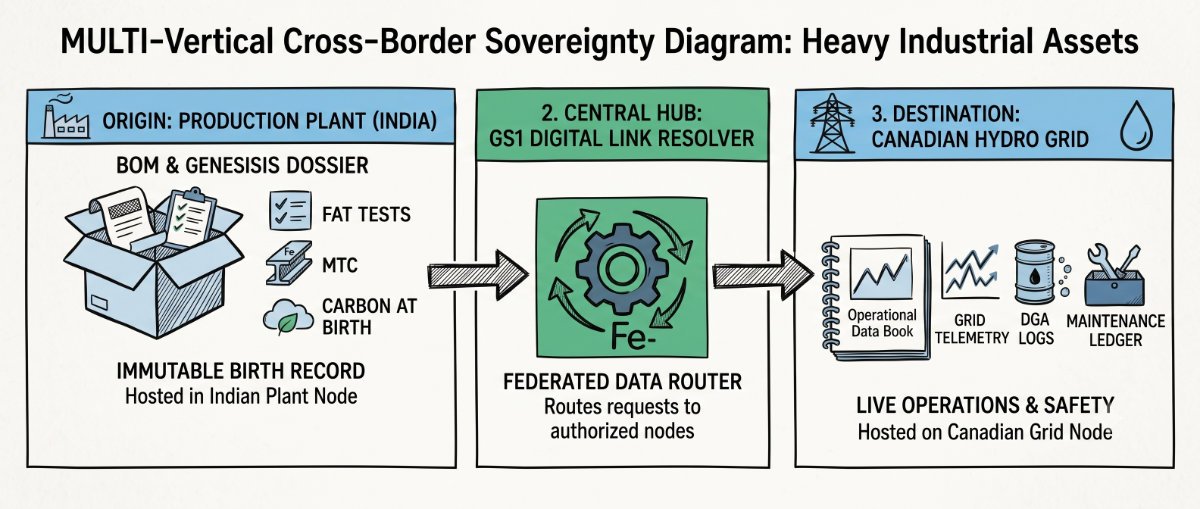
Critical grid telemetry, load logs, and substation health data remain locked inside host country utility nodes, while factory birth specifications and MTC material certificates reside in origin vaults.
| Data Category | Hosting Location | Reason & Compliance |
|---|---|---|
| Birth / Manufacturing Provenance BOM, copper winding purity, CRGO steel heat numbers, Factory Acceptance Test (FAT) certificates, embodied carbon. |
Origin Manufacturer Vault | ISO 9001 Quality Standards, EU ESPR Ecodesign Mandates |
| Operational & Maintenance Records Dissolved Gas Analysis (DGA), Buchholz relay alerts, oil temperature tracking, field service logs. |
Destination Grid Region | National Critical Infrastructure Security Laws, IEEE C57 Standards |
| Ownership & Customs Transfer Ledger Chain of custody, port clearance seals, eIDAS digital signatures, warranty state. |
Federated Edge Resolver | EU NIS 2 Directive (Art. 20/21), US SCRM Supply Chain Mandates |
A. Ruggedized Physical-to-Digital Carriers
Transformers feature stainless-steel laser-etched plates or industrial NFC tags encoding GS1 Digital Link URIs:
Customs agents scan to review material origin and carbon declarations; field engineers scan to unlock single-line CAD diagrams and oil sampling schedules.
B. Outbound-Only Defense-in-Depth Telemetry
Substation edge gateways aggregate local Modbus/OPC-UA sensor telemetry without exposing control planes:
- Outbound-only MQTT/HTTPS communication ensuring zero open inbound ports to high-voltage equipment.
- Role-based OTP gateways restricting engineering schematics to authorized utility personnel.
- Cryptographically chained audit trails preserving 20+ year asset maintenance histories.
3. End-to-End Heavy Asset Export Lifecycle Sequence
Factory Testing & Mintage (Production Plant 1)
Dielectric breakdown testing, core loss reports, and NABL inspection documents are sealed into the Genesis Dossier with RSA-4096 cryptographic signatures.
Port Transit & Customs Clearance
Border officials scan the physical steel tag to verify compliant material provenance and eIDAS seals directly from the origin vault.
Substation Commissioning & Operational Phase (Destination Grid)
The host utility takes operational ownership. All subsequent DGA oil tests, load telemetry, and field repairs are appended exclusively to the destination regional container.